Wavu
2026A 3D fighter built around the Mishima Wind God Step, with a fully deterministic fixed-point simulation, GGPO-style rollback netcode, and a browser build whose online play runs peer to peer over WebRTC.
- C#
- Unity
- WebGL
- WebRTC
- Cloudflare Workers
The repository is private. The game itself is public and playable below.
The game itself
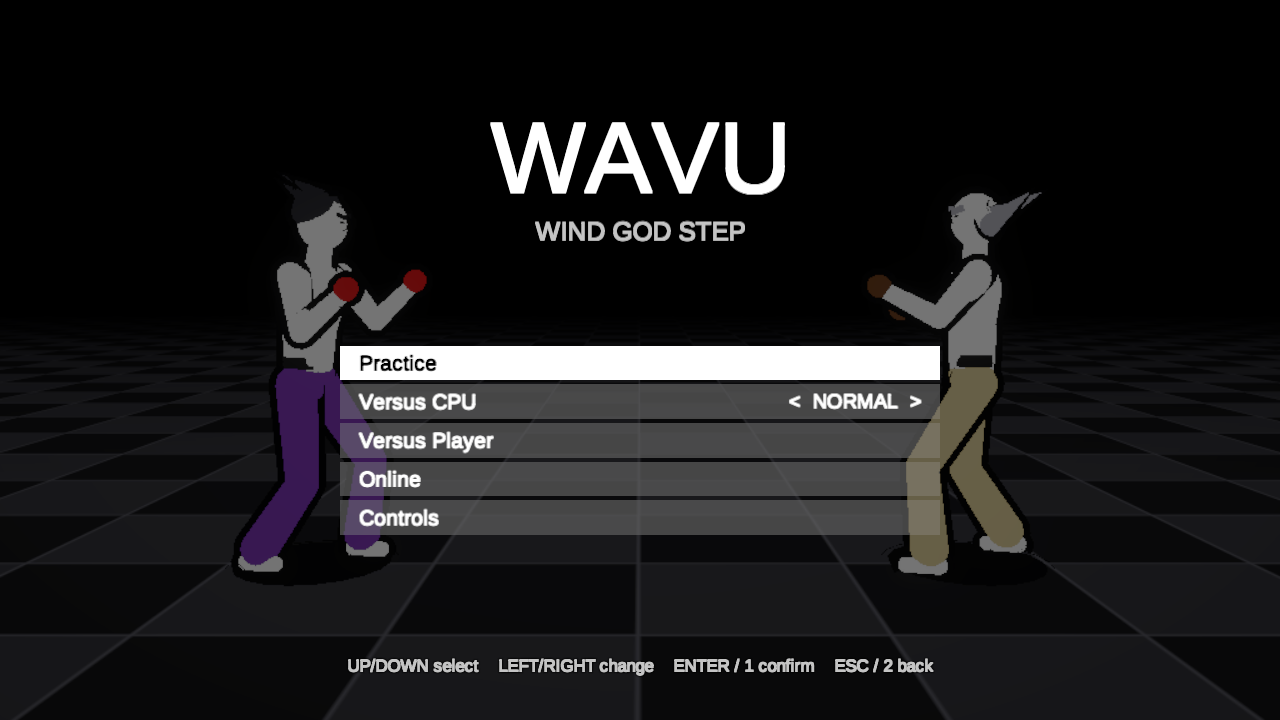
PlayableThe real WebGL build. Keyboard: WASD to move, U and I to attack. Gamepads work too.
Loads wavu.roshanarun.com in a sandboxed frame.
Wavu is a Tekken-style 3D fighter built around one of the genre's hardest techniques, the Mishima Wind God Step. Unity renders it, but Unity does not run the fight: the match is a separate simulation package with no engine dependency, and the game only draws what that simulation says.
That split exists because of rollback netcode. When a remote input arrives late, the game rewinds to the frame it applies to and re-simulates forward, possibly several times a second. That only works if the simulation is perfectly deterministic, so every number in it is Q47.16 fixed point — the only non-trivial function is an integer square root — and a full match state can be cloned, restored and checksummed.
Rendering follows the same rule. Unity's Animator never runs on its own clock; every frame, a fighter's pose is sampled as "clip X at frame N" from the simulation state. A rollback therefore always shows the correct pose, and the animations are authored so that a correction a few frames late reads as a slightly quicker start rather than a teleport.
The browser build plays the same as the desktop one, including online. Browsers cannot open UDP sockets, so a Cloudflare Worker pairs players by lobby code — each lobby is a Durable Object — and passes the WebRTC handshake between them. Game packets then travel directly between the two browsers over an unordered, unreliable data channel, falling back to a relay only when a direct path is impossible.
What it does
- Deterministic Q47.16 fixed-point simulation with no engine dependency
- GGPO-style rollback: input prediction, resimulation, desync checksums
- Netcode tested over a simulated network with jitter and 15% packet loss
- Browser online play over WebRTC, paired by a Durable Object lobby server
- Desktop and browser players can play each other through the same lobbies
Problems worth writing down
Rollback means a frame may be simulated, thrown away and re-simulated with corrected inputs. Any floating-point maths, engine physics or animation clock would let two machines drift apart and desync.
The simulation is its own package with no UnityEngine dependency, all in Q47.16 fixed point, and `Battle.Tick` is the only way state advances. The only thing sent over the network is six bits of controller state per frame, and exchanged checksums catch a desync the moment it happens.
After a rollback, a fighter's pose can jump straight to frame N of what it is really doing, which reads as a teleport.
Poses are sampled from simulation state rather than played by the Animator, and moves are authored to stay close to their starting pose for the first two or three frames. A correction that lands inside that window looks like a slightly quicker start.